WD Ultrastar Enterprise Hard Drives in Oman
Data centre drives for servers, storage arrays and hyperscale environments. 4 TB to 32 TB in SATA and SAS, with SED and FIPS options.
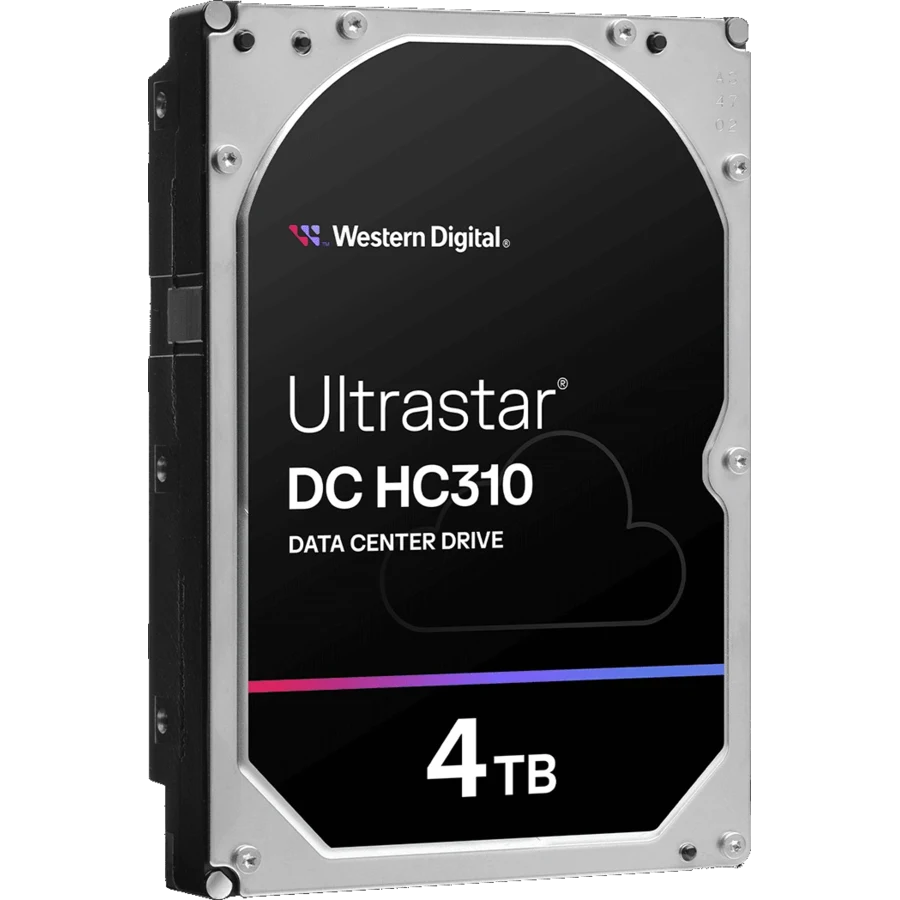
The first Ultrastar decision is not capacity. It is CMR or UltraSMR
Getting it wrong produces a storage tier that benchmarks beautifully and then collapses under the wrong workload.
CMR series (HC310 through HC590) handle mixed random read and write and belong under anything transactional. UltraSMR series (HC650, HC670, HC680, HC690) reach 32 TB by overlapping tracks, which makes them exceptional for sequential-write archive and cold storage and unsuitable for random rewrite.
Elite Infotech supplies the Ultrastar DC range across Oman for servers, storage arrays, backup targets and archive tiers. Tell us the workload and the platform it is going into, and we will confirm the series, the interface and the security variant before anything is ordered. A drive bought against the wrong recording technology cannot be corrected in firmware later.
Choose the recording technology before the capacity
Conventional magnetic recording
Writes tracks side by side and handles random read and write predictably. This is the default for anything transactional: virtualisation hosts, database tiers, general-purpose file servers and storage arrays.
Shingled magnetic recording
Overlaps tracks to reach higher capacity, so rewriting a region requires rewriting the surrounding band. Exceptional for sequential-write archive and cold storage; unsuitable for random rewrite.
The most common enterprise storage mis-specification
Do not quote UltraSMR into a virtualisation host, database tier or general-purpose file server. It is the single most common enterprise storage mis-specification and the performance complaint arrives three months after commissioning.
The Ultrastar DC series available in Oman
Sector format (512e or 4Kn), exact part numbers, power figures and sustained transfer rates vary by SKU and revision. Confirm at quotation.
CMR series: general enterprise workloads
| Series | Capacities | Interface | Design | Notes |
|---|---|---|---|---|
| HC310 | 4 TB, 6 TB | SATA / SAS | Air | 256 MB cache, 2M hr MTBF, 0.44% AFR |
| HC320 | 8 TB | SATA / SAS | Air | 256 MB cache, ~2M hr MTBF |
| HC330 | 10 TB | SATA / SAS | Air | 256 MB cache, ~2M hr MTBF |
| HC520 | 12 TB | SATA / SAS | Helium | 2.5M hr MTBF, 0.35% AFR, 550 TB/yr |
| HC530 | 14 TB | SATA / SAS | Helium | ~255–262 MB/s sustained |
| HC550 | 14, 16, 18 TB | SATA / SAS | Helium | 512 MB cache on later revisions, ~262–269 MB/s |
| HC555 | 12, 14, 16, 18, 20 TB | SATA | Helium | 512 MB cache, up to 285 MB/s on 20 TB |
| HC560 | 20 TB | SATA / SAS | Helium | Up to ~291 MB/s sustained |
| HC570 | 22 TB | SATA / SAS | Helium | 2.5M hr MTBF, 550 TB/yr |
| HC580 | 24 TB | SATA / SAS | Helium | 2.5M hr MTBF, 550 TB/yr |
| HC590 | 26 TB | SATA / SAS | Helium | Highest CMR capacity in the range |
SMR and UltraSMR series: archive and sequential workloads
| Series | Capacities | Interface | Technology | Best fit |
|---|---|---|---|---|
| HC620 | 15 TB (2.5-inch) | SAS | SMR | High-density enterprise, 2.5-inch chassis |
| HC650 | 20 TB | SATA / SAS | SMR | Sequential write-intensive workloads |
| HC670 | 26 TB | SATA / SAS | UltraSMR | Cold storage and archive |
| HC680 | 26–28 TB | SATA / SAS | UltraSMR | Hyperscale archive, ArmorCache on some models |
| HC690 | 30–32 TB | SATA / SAS | UltraSMR | Maximum density archive |
Stock varies by series and capacity. Send your requirement and we will confirm availability and lead time.
Specifications common to the family
Series-specific figures are in the tables above. Exact values vary by SKU and revision.
| Specification | Value |
|---|---|
| Spindle speed | 7,200 RPM |
| Form factor | 3.5-inch (HC620 is 2.5-inch) |
| Interface | SATA 6 Gb/s or SAS 12 Gb/s |
| Workload rate limit | Typically up to 550 TB/year |
| MTBF | 2.0–2.5 million hours by series |
| Annualised failure rate | 0.35–0.44% by series |
| Nonrecoverable read errors | 1 in 1015 bits read |
| Load/unload cycles | 600,000 |
| Vibration handling | Rotational Vibration Safeguard (RVS) |
| Actuator | Dual-stage on many models |
| Security options | Base/SE, SED (TCG), SED-FIPS on select SKUs |
| Operating temperature | Typically 5–60°C, model dependent |
| Availability | 24×7 |
| Limited warranty | 5 years |
| Dimensions | 101.6 × 147 × 26.1 mm |
SATA or SAS, and the security variant
Two ordering decisions that are difficult to change after the array is populated.
SATA or SAS. SATA is the correct answer for single-controller servers and cost-sensitive capacity tiers, and it is what most Ultrastar in Oman ships as. SAS earns its premium in enterprise arrays that need dual-port paths to two controllers, so a controller failure does not take the shelf offline. SAS also carries better error reporting and command queuing under heavy multi-initiator load. If the array vendor specifies SAS on the compatibility list, treat that as a requirement rather than a preference. Mixing interfaces across a shelf is not something to discover during commissioning.
The security variant is not a firmware toggle. Ultrastar ships in distinct SKUs: base or SE, SED with TCG self-encrypting support, and SED-FIPS validated to the FIPS 140 standard on select models. The drive is manufactured as one of these and cannot be converted afterwards, so specifying it at order stage is the whole game.
For government, defence and banking work in Oman where drive retirement and media sanitisation are audited, SED is what makes decommissioning practical. A cryptographic erase renders the media unreadable in seconds rather than requiring a multi-pass overwrite or physical destruction of a 24 TB drive. FIPS-validated variants carry longer lead times and require host or controller support for TCG, which is worth confirming against the platform before the requirement reaches a tender document.
Where Ultrastar DC is specified in Oman
- Virtualisation hosts and hyperconverged nodes: CMR series only
- Enterprise storage arrays and SAN or NAS head units
- Backup and restore targets, disk-to-disk and virtual tape
- Government and banking storage requiring SED or FIPS-validated drives
- Oil and gas seismic and sensor data archives: UltraSMR is a strong fit here
- Centralised long-term surveillance archive behind multi-site recorders
Frequently asked questions
What is the difference between CMR and UltraSMR Ultrastar drives?
CMR writes tracks side by side and handles random read and write predictably. UltraSMR overlaps tracks to reach higher capacity, which makes rewriting a region require rewriting the surrounding band. UltraSMR is excellent for sequential archive and poor for random rewrite. Choose CMR unless the workload is genuinely write-once, read-many.
Should I choose SATA or SAS?
SATA for single-controller servers and cost-sensitive capacity tiers. SAS for enterprise arrays needing dual-path redundancy, and for the higher-tier security variants.
Are FIPS-validated Ultrastar drives available in Oman?
SED-FIPS variants are available on select SKUs. Lead times are longer than standard models and the host or controller must support TCG. Contact us with the compliance requirement.
Can Ultrastar drives be used for surveillance recording?
They will work, and Ultrastar is often the right answer for a centralised archive tier. For the recorder itself, WD Purple or Purple Pro use firmware tuned for continuous multi-stream video write, which Ultrastar does not.
What warranty applies?
A five-year limited manufacturer warranty across the Ultrastar DC family. We process claims directly.
Where to go next
Request Ultrastar Stock and Pricing
Send your capacity requirement, interface, workload type and any encryption need. We confirm series, model numbers and lead time within 24 hours.