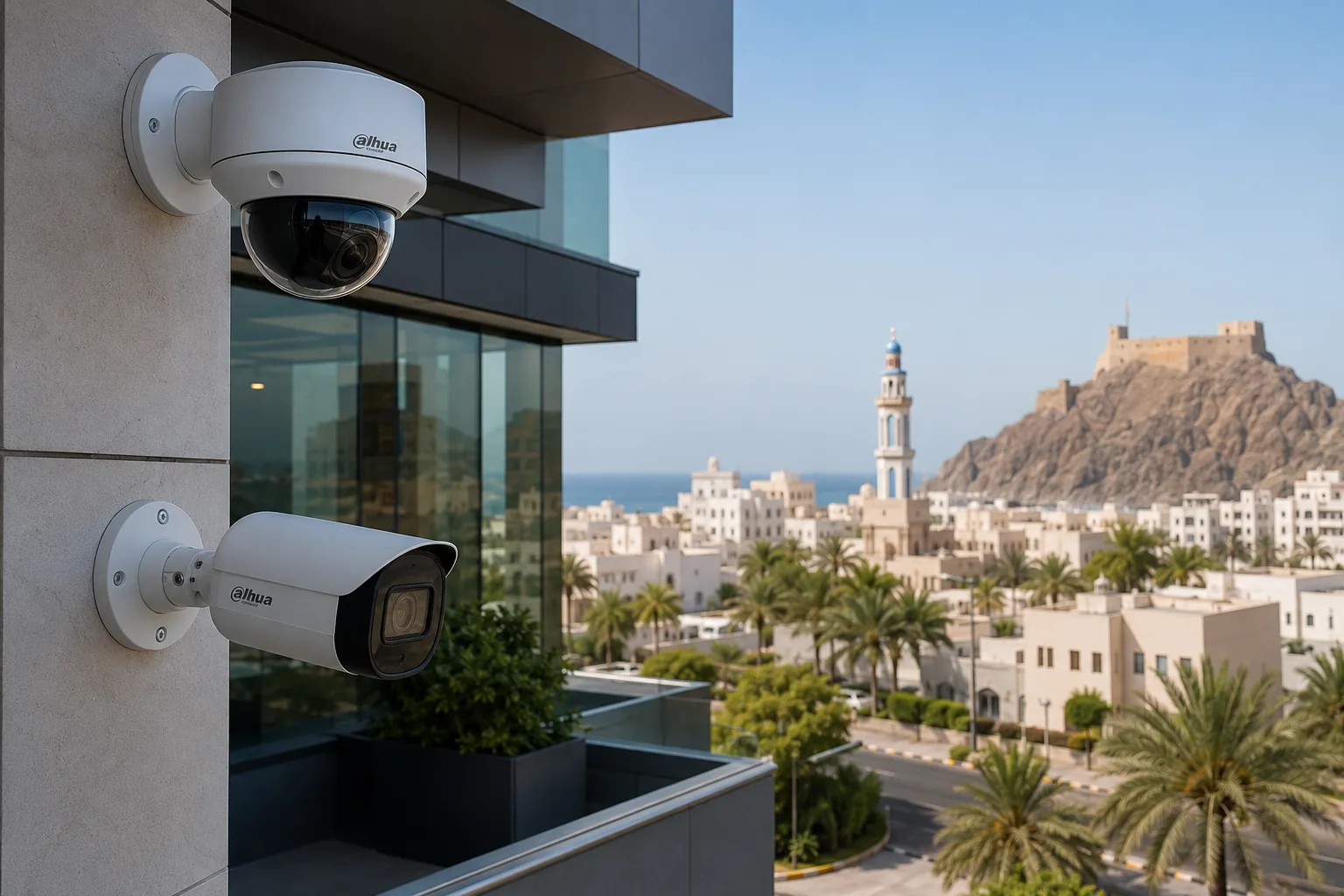
An IP camera is a CCTV camera that sends video as data over a network cable instead of an analog signal down coax. For most new business installations in Oman, it is the better long-term choice.
- 4 MP PoE is the sensible general standard; 4K at gates and car parks.
- Budget for the network too: PoE recorder or switch, surveillance-grade disk, Cat6 in conduit, and a UPS.
- Recording is local. You only need internet for remote viewing on your phone.
Search for IP cameras in Oman and you will mostly find product listings: rows of models, zero explanation. That is fine if you already know your pixels from your pitch.
If you are choosing a system for your villa, shop or warehouse, the real questions go unanswered. Is IP actually better than normal CCTV? What should it cost in rials? And what do you need besides the cameras themselves?
This guide answers those questions the way we answer them for customers every week, in plain terms, for Omani conditions.
What Is an IP Camera, and How Is It Different from CCTV?
An IP (Internet Protocol) camera sends video as data over a network. An older analog camera sends it as a signal down a coaxial cable. Each IP camera is effectively a small computer with its own address on your network.
IP cameras are CCTV. The useful comparison is against older analog and HDCVI systems:
| Analog / HDCVI CCTV | IP camera system | |
|---|---|---|
| Resolution | Usually 2–5 MP | 2 MP to 12 MP (4K and above) |
| Cabling | Coax plus separate power | Single Cat6 cable: PoE carries power and video |
| Recorder | DVR | NVR |
| Zoom on playback | Limited detail | Much more usable detail |
| Smart features | Basic | Human and vehicle detection, line-cross, face detection |
| Expansion | New cable run per camera | Add to the network switch |
| Cost | Lower upfront | Roughly 40–70% more upfront, better value long-term |
Neither is “wrong”. Analog still makes sense for small budgets and simple sites. We compared both in detail in our Dahua CCTV camera price guide for Oman. But for new installations in 2026, most Omani businesses choose IP, and Oman's fibre rollout makes remote viewing from anywhere effortless.
Types of IP Cameras Used in Oman
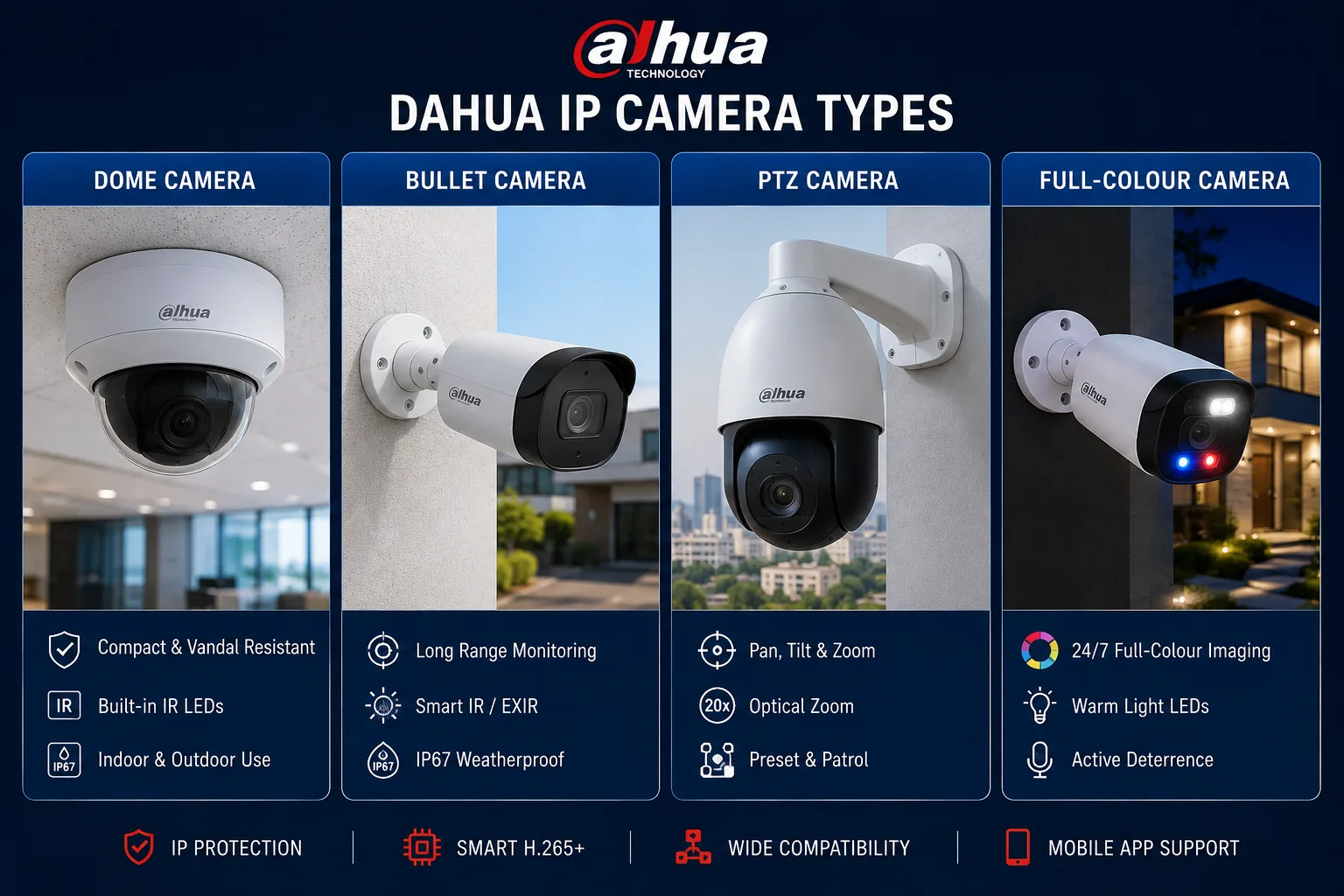
- Dome cameras: discreet and vandal-resistant, ideal indoors and under ceilings: shops, offices, mosques and schools.
- Bullet cameras: a visible deterrent with longer IR range; the default choice for gates, boundary walls and parking. IP67 housings handle Omani dust and 50 °C summers.
- PTZ cameras: pan-tilt-zoom for large areas such as warehouses, ports and farms. One PTZ can patrol what three fixed cameras cover, but do not rely on PTZ alone for evidence: pair it with fixed cameras.
- Full-colour cameras: keep colour video at night using ambient light. Worth the premium at entrances and cash counters.
- Wi-Fi and battery cameras: fine for a single room or a rental flat, but not the backbone of a business system. Cabled PoE is simply more reliable.
- AI cameras: Dahua WizSense and similar ranges filter out moving trees and stray cats, alerting only on people and vehicles. This turns phone notifications from noise into something you actually read.
Browse the current range on our Dahua CCTV cameras and surveillance camera systems pages.
What You Need Besides the Cameras
A working IP system is a small network. Budget for all of it, not just the cameras:
- A PoE NVR or PoE switch: powers cameras through the data cable, so no separate power cabling is needed.
- A surveillance-grade hard disk: sized to your retention needs. Thirty days on four 4 MP cameras is roughly 2 TB. See Seagate surveillance drives in Oman for models rated for 24/7 recording.
- Cat6 cabling in conduit: Oman's heat and UV destroy exposed cheap cable.
- A UPS: even twenty minutes of battery keeps recording through the brief power cuts.
- Decent internet upload speed: only needed for remote viewing. Recording itself is local.
Storage is the line most often guessed at. Our NVR storage sizing guide gives the formula and three worked examples, and the Dahua NVR and storage range lists the recorders themselves. For remote viewing, our DMSS and SmartPSS setup guide covers getting into the system from outside the site.
IP Cameras and the Law in Oman
Surveillance of your own premises is legal and, for many commercial activities, expected. Royal Oman Police licensing requirements for certain businesses (banks, gold shops, fuel stations, hotels and others) specify camera coverage and retention periods.
Two practical rules apply to everyone: do not point cameras into neighbours' private property, and place a visible notice where the public is recorded.
If your activity needs ROP-compliant CCTV, ask us. We design to those specifications routinely across the industries we serve in Oman.
How to Choose: A 6-Point Checklist
- Coverage plan first, camera count second. Walk the site and mark entries, cash points and blind corners before anyone quotes a number.
- Pick resolution per position. 4 MP as the general standard, 4K at gates and car parks.
- Insist on PoE for anything beyond two cameras.
- Check night performance where it matters: IR range in metres, or full-colour at key entrances.
- Confirm genuine hardware and local warranty: serial-verified, from an authorized distributor. Our distributor verification guide explains how to check in ten minutes.
- Ask who maintains it. Firmware updates and a phone number that answers matter more than spec sheets.
Specify by position, not by package. A four-camera “kit” priced for a villa rarely puts the right camera at the gate, and the gate is the shot you will actually need.
Still weighing Dahua against the alternatives? Our Dahua vs Hikvision comparison is written from a distributor's desk and says where each brand wins.