
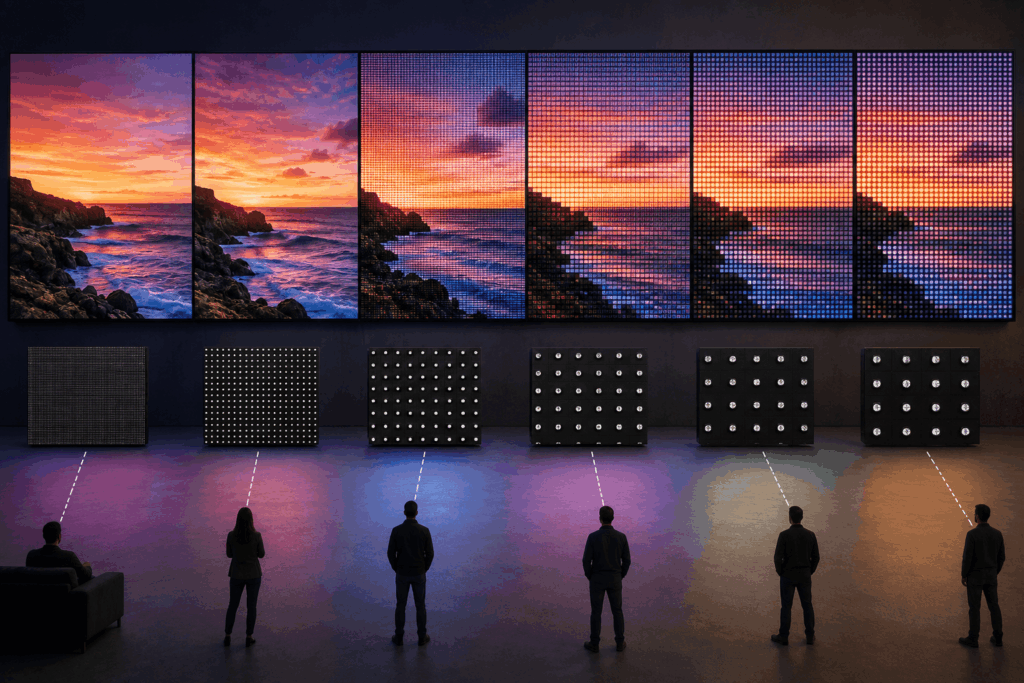
Ask three different LED suppliers what pixel pitch you need, and you might get three different answers — usually delivered with a confidence that makes you nervous to ask a follow-up question. The truth is, pixel pitch is one of the more straightforward specs once someone actually explains it in plain terms.
Here’s what it means, how it affects what you see, and how to figure out which pitch actually fits your space.
Quick Answer
Pixel pitch is the distance, in millimeters, between the centers of two adjacent LEDs on a screen. A smaller number (like P1.5) means LEDs are packed closer together for a sharper image up close, while a larger number (like P10) spaces LEDs further apart, which works fine when viewers stand farther away, such as outdoor billboards. The right pixel pitch depends almost entirely on how close your audience will actually be.
Key Takeaways
- Pixel pitch is the distance in millimeters between adjacent LEDs — smaller numbers mean a denser, sharper image.
- The right pixel pitch depends on viewing distance, not on chasing the “best” spec available.
- Fine pitch (P1.5–P2.5) suits close-up indoor viewing; wider pitch (P6–P10) suits outdoor and long-distance viewing.
- Going finer than your space needs adds cost without adding visible image quality.
- Ambient lighting and content type (video vs. static text) also affect which pitch looks best.
What Is Pixel Pitch, Exactly?
Pixel pitch refers to the distance, measured in millimeters, from the center of one LED to the center of the next LED beside it. It’s written as a “P” followed by a number — P2.5 means 2.5mm between LED centers, P10 means 10mm between them.
The smaller that number, the more LEDs are packed into each square meter of screen, which means more individual points of light making up the image. More points of light generally means a sharper, more detailed picture — but only if you’re standing close enough to actually notice the difference.
How Pixel Pitch Affects Viewing Distance
This is the part that trips people up: pixel pitch isn’t about which screen “looks best” in the abstract. It’s about matching LED density to how far away your audience will actually be standing.
A commonly used rule of thumb in the industry is that the minimum comfortable viewing distance, in meters, is roughly equal to the pixel pitch in millimeters — so a P3 screen is generally viewed well from about 3 meters back, while a P10 screen needs more like 8–10 meters before individual LEDs stop being visible to the eye. Exact numbers vary by manufacturer and by how good someone’s eyesight is, but the pattern holds: tighter pitch for close viewing, wider pitch for distant viewing.
This is exactly why a control room screen viewed from 1 meter away uses a much finer pitch than a stadium screen viewed from across a field — the stadium screen doesn’t need that density because nobody’s standing close enough to see individual LEDs anyway.
Pixel Pitch Comparison Table
Here’s a general breakdown of common pixel pitches, their approximate minimum viewing distance, and where each one is typically used.
| Pixel Pitch | Approx. Viewing Distance | Best For |
|---|---|---|
| P1.5 | 0.8m and closer | Control rooms, broadcast studios, close-up retail displays |
| P2.5 | 1.5m and closer | Indoor conference rooms, lobbies, retail walls |
| P3 | 2m and closer | Indoor stages, showrooms, meeting spaces |
| P4 | 3m and closer | Larger indoor venues, semi-outdoor canopy screens |
| P6 | 5m and closer | Event stages, exhibition booths, semi-outdoor signage |
| P10 | 8m and closer | Outdoor billboards, stadium screens, building facades |
Treat the viewing distances as a starting guide, not a hard rule — factors like screen brightness, content type, and individual eyesight shift these numbers somewhat in real installations. For a fuller sense of how price scales with pitch and brightness, see our LED Screen Price in Saudi Arabia guide before requesting quotes.
Which Pixel Pitch Should You Choose?
Control Rooms and Close-Viewing Retail
If viewers stand within a meter or two — think security control rooms, small retail displays, or reception desks — a fine pitch like P1.5 or P2.5 is worth the extra cost, since the detail is actually visible at that range.
Conference Rooms and Lobbies
For indoor spaces where people typically sit or stand 2–5 meters away, P2.5 to P3 usually hits the right balance of sharpness and cost, without paying for resolution nobody in the room can perceive.
Events and Exhibition Booths
Stages and booths often have a mixed audience distance — some people close, most further back. P4 to P6 is a common middle ground here, especially for screens that need to travel and get reassembled repeatedly.
Outdoor Billboards and Stadiums
When your audience is 8 meters away or more, a wider pitch like P8 or P10 is not a compromise — it’s the correct choice for an outdoor screen. It also tends to be more cost-effective per square meter for the very large surface areas outdoor screens usually need.
For more on how indoor and outdoor builds differ beyond just pitch, see our guide on outdoor vs indoor LED screens.
Common Pixel Pitch Mistakes to Avoid
- Choosing the finest pitch available assuming it’s automatically “better,” even when the viewing distance doesn’t justify it
- Ignoring ambient light — a screen in direct sunlight needs enough brightness to stay visible regardless of pitch
- Forgetting that very fine pitch panels are more sensitive to dust and handling, which matters for screens that get moved between events
- Not accounting for the closest point a viewer could realistically stand, not just the average distance
If you’re not sure which category your project falls into, it helps to talk it through with a supplier who can look at your actual space rather than guessing from a spec sheet. Elite Infotech’s team walks through viewing distance and lighting conditions with every project before recommending a pitch, so you’re not paying for resolution you’ll never see.
Frequently Asked Questions
What is pixel pitch in an LED screen?
Pixel pitch is the distance in millimeters between the centers of two adjacent LEDs on the display. It determines how dense the LED array is, which affects image sharpness at a given viewing distance.
What pixel pitch do I need for my viewing distance?
As a general guide, the minimum comfortable viewing distance in meters roughly matches the pixel pitch in millimeters — a P4 screen is typically viewed well from about 4 meters back. Closer viewing needs a finer pitch.
What’s the difference between P2.5 and P3 LED screens?
A P2.5 screen has LEDs spaced 2.5mm apart, slightly denser than P3’s 3mm spacing. In practice, P2.5 looks marginally sharper up close, but at typical indoor viewing distances of 3–5 meters, most people won’t notice a meaningful difference.
Does a lower pixel pitch always mean better quality?
Not necessarily better overall — it means higher resolution and density, which only translates to a visibly better image if viewers are close enough to see it. For distant viewing, a finer pitch just adds cost without a visible benefit.
What pixel pitch is best for outdoor advertising?
Outdoor billboards and building facades typically use P6 to P10, since viewers are usually several meters or more away and outdoor screens also need higher brightness to stay visible in daylight.
Choosing the Right Pitch for Your Project
Pixel pitch sounds technical, but it really comes down to one question: how close will people actually be standing? Get that right, and the rest of the decision — P2.5 versus P4, P6 versus P10 — becomes a lot more obvious. If you’re still weighing options for a specific space, it’s worth getting a second opinion from someone who can look at your actual layout before you commit to a spec.