
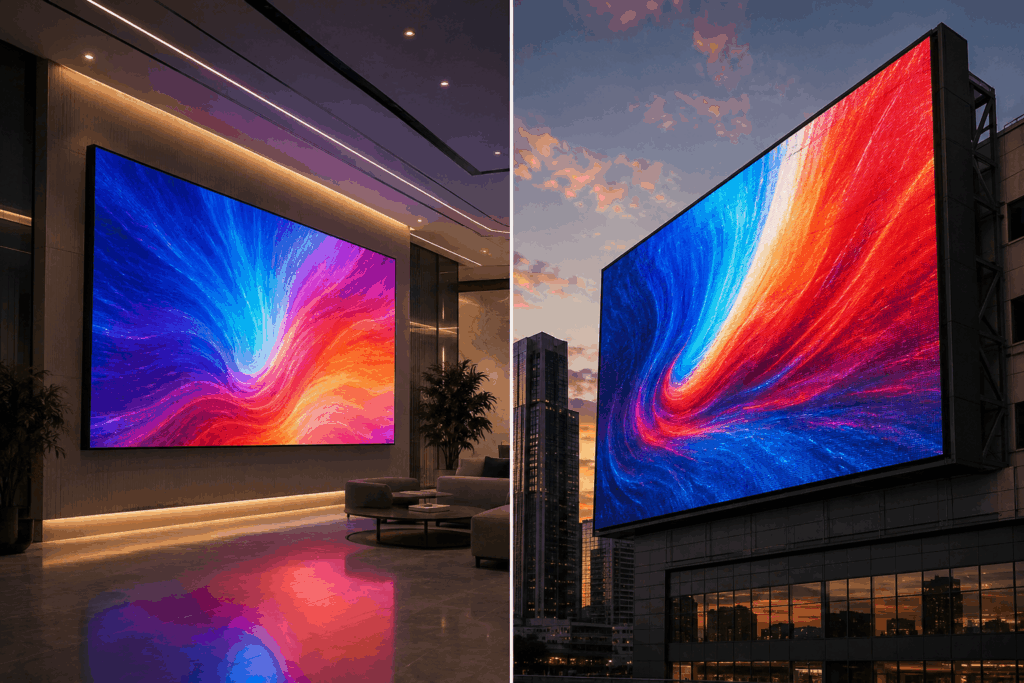
Two LED screens can look nearly identical in a spec sheet photo and still be built for completely different jobs. One is designed to survive a Jeddah summer bolted to the outside of a building; the other would fail within weeks in that same spot. The difference isn’t obvious until you know what to look for.
Here’s what actually separates outdoor LED screens and indoor LED screens, and why that distinction matters for both performance and price.
Quick Answer
Indoor and outdoor LED screens differ mainly in weatherproofing and brightness. Outdoor screens use sealed, IP65-rated (or higher) housings to resist rain and dust, and run far brighter to stay visible in direct sunlight, while indoor screens rely on controlled lighting and simpler enclosures. These differences are also why outdoor screens generally cost more than an indoor screen of the same size.
Key Takeaways
- Outdoor screens are sealed against weather and run far brighter than indoor screens of the same size.
- Indoor screens use finer pixel pitch since viewers typically stand closer.
- An indoor screen generally can’t be repurposed outdoors without failing quickly.
- Outdoor screens cost more per square meter due to housing, brightness, and structural requirements.
- Semi-outdoor spaces need a case-by-case decision, not an automatic indoor or outdoor default.
What Makes a Screen “Indoor” or “Outdoor”?
The classification comes down to two things: how the panel is sealed against the elements, and how bright it can get.
Outdoor panels are built with sealed housings rated for dust and water resistance, commonly IP65 or higher, so rain and dust don’t reach the internal electronics. They also include drainage paths, since even a sealed housing needs somewhere for condensation or driven rain to go. Indoor panels skip most of this, since they never face weather in the first place — which keeps their construction simpler and their cost lower.
Brightness is the second half of the equation. Indoor screens are designed for controlled, relatively dim environments, so they don’t need to output much light to look vivid. Outdoor screens have to compete with direct sunlight, which can be dozens of times brighter than typical indoor lighting — so outdoor panels are built with far more powerful LEDs to stay visible at midday.
Key Differences at a Glance
| Factor | Indoor Screens | Outdoor Screens |
|---|---|---|
| Weatherproofing | Not required | IP65 or higher, sealed housing |
| Typical brightness | 800 – 1,500 nits | 5,000 – 8,000+ nits |
| Common pixel pitch | P1.5 – P4 (finer, close viewing) | P6 – P10 (wider, distance viewing) |
| Structure needs | Simple wall mount or frame | Wind load rated, drainage included |
| Relative cost | Lower per sqm | Higher per sqm |
Pixel pitch differences here reflect typical viewing distances for each setting more than the indoor/outdoor classification itself — an outdoor screen viewed up close would still benefit from a finer pitch, it’s just less common in practice. (See our LED Screen Pixel Pitch guide — link once that post is published.)
Can You Use an Indoor Screen Outdoors?
Generally, no — and this is one of the more expensive mistakes buyers make when trying to save money upfront. Indoor panels lack the sealed housing needed to keep out moisture and dust, so even light rain or humidity can cause internal corrosion and panel failure over time. Their brightness also falls well short of what’s needed to stay readable outdoors, especially in direct sun.
The reverse works better in a pinch: an outdoor-rated screen can usually be used indoors without issue, since it exceeds the durability an indoor space requires. It’s just typically overbuilt (and overpriced) for that use case, since you’re paying for weatherproofing you don’t need.
Best Applications for Each Type
Indoor Applications
- Retail walls, showrooms, and product displays
- Conference rooms, lobbies, and reception areas
- Control rooms and broadcast studios
- Indoor exhibition booths and trade show displays
Outdoor Applications
- Building facades and architectural lighting displays
- Billboards and roadside advertising
- Stadium and outdoor venue screens
- Outdoor plazas, mall entrances, and open-air retail signage
Why Outdoor Screens Cost More
The price gap between indoor and outdoor screens of the same size comes from three stacked factors: the sealed housing itself, the more powerful (and more expensive) LEDs needed for outdoor brightness, and the sturdier mounting structure required to handle wind load and weather exposure over years of use.
None of these are optional extras for an outdoor installation — they’re what makes the screen survive its environment at all. For a full breakdown of what drives LED screen pricing more broadly, including indoor projects, it’s worth reading through the complete cost guide before requesting quotes. (See our LED Screen Price in Saudi Arabia guide — link once that post is published.)
Semi-Outdoor: The Middle Ground
Covered entrances, shaded walkways, and canopy areas don’t fit neatly into either category. They’re protected from rain most of the time but may catch direct sunlight during parts of the day, which means brightness needs can vary significantly depending on orientation and time of year.
These spaces are worth walking through in person, at the time of day they get the most light, before deciding whether to spec them as indoor, outdoor, or something in between. Getting this wrong in either direction means either an underpowered screen that washes out in afternoon sun, or an overbuilt one that costs more than the space actually needs.
If you’re weighing this decision for a specific site, it helps to talk through the exact location and orientation with a supplier who can assess it directly rather than guessing from a general rule.
Frequently Asked Questions
What’s the difference between indoor and outdoor LED screens?
Outdoor screens have sealed, weatherproof housings and much higher brightness to stay visible in direct sunlight. Indoor screens rely on controlled lighting and skip weatherproofing, which keeps them simpler and less expensive.
Can an indoor LED screen be used outdoors?
Not reliably. Indoor panels lack weatherproofing, so exposure to rain or humidity can damage internal components, and their brightness usually isn’t enough to stay readable in direct sunlight.
What IP rating does an outdoor LED screen need?
Outdoor LED screens are commonly rated IP65 or higher, meaning they’re fully protected against dust and can withstand water jets or driven rain, depending on the exact rating.
Why are outdoor LED screens more expensive?
The added cost comes from sealed weatherproof housings, more powerful LEDs needed for sunlight-level brightness, and sturdier mounting structures built to handle wind and long-term outdoor exposure.
What are the best applications for indoor vs outdoor LED screens?
Indoor screens suit retail walls, lobbies, conference rooms, and control rooms. Outdoor screens suit building facades, billboards, stadiums, and open-air plazas where the screen faces direct sunlight and weather.
Choosing the Right Category for Your Project
Indoor and outdoor LED screens solve different problems, and the classification isn’t just a label — it reflects real engineering differences that affect both how the screen performs and what it costs. If your space doesn’t clearly fall into one category, that’s worth flagging early, since it’s far easier to spec correctly the first time than to retrofit a screen that’s underperforming in its environment.
Explore our full range at Elite Infotech.