
If you are choosing a commercial display for your business — a video wall in your reception, a menu board for your restaurant, a billboard outside your showroom, or a control room screen — the LED versus LCD question comes up early. The names sound similar, the spec sheets look similar, but the two technologies behave very differently in real installations. Pick the wrong one and you spend the next five years either replacing screens too early or paying for a level of performance you never needed.
We have installed both LED and LCD displays across Oman for over 12 years — in shopping malls in Muscat, hotel lobbies in Salalah, refinery control rooms in Sohar, and storefronts on the Al Khuwair strip. This guide is the same advice we give clients before they buy: a clear breakdown of how the two technologies actually differ, where each one wins, and how Oman’s climate changes the answer.
LED is the better choice for outdoor displays, large video walls, and any screen viewed from more than 3 metres away. LCD is the better choice for indoor screens viewed up close — menu boards, lobby information panels, retail displays under 65 inches.
Both technologies have become more capable over the last decade, but the use cases where one clearly beats the other have not changed. Rule of thumb: if your viewers stand within 3 metres, start with LCD. If further than 3 metres, start with LED. Then adjust for outdoor exposure, ambient light, and budget.
How LED and LCD Actually Differ
Both technologies use pixels, but they light those pixels in fundamentally different ways. This single difference drives every other spec — brightness, lifespan, cost, viewing angle, and where the display can physically go.
LCD — Liquid Crystal Display
An LCD panel uses a layer of liquid crystals sandwiched between two polarising filters. The crystals do not produce light themselves; they only let it through or block it. Behind the crystal layer sits a backlight — usually a strip of small LEDs (which is why most modern LCDs are confusingly marketed as “LED TVs”). The backlight provides the illumination, and the liquid crystals act as a million tiny shutters opening and closing to form the image.
Because the backlight is uniform and always on, LCD struggles with deep blacks. Even in a fully black scene, some light leaks through — this is what gives LCDs their characteristic “glowing” look in dark images.
LED — Direct‑View Light Emitting Diode
A direct‑view LED display is built differently. Each pixel is a tiny cluster of red, green, and blue LEDs that emit their own light. There is no backlight, no liquid crystal layer, no shutters. When a pixel needs to be black, those LEDs simply switch off — producing true blacks impossible on LCD.
The other consequence is scale. LED panels are built as modular tiles that bolt together with no visible bezel between them. You can build a 4‑metre wall, a curved facade, a non‑rectangular sculpture — there is no panel size limit. LCD video walls always show seams between panels, even with the thinnest “3.5mm bezel” professional models.
LED vs LCD Specifications Side‑by‑Side
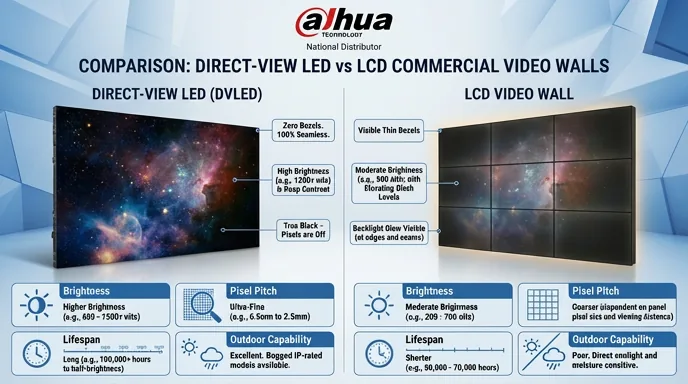
Here is the technical comparison we send to clients during the proposal stage. The numbers are commercial-grade ranges from manufacturers we deal with directly — Dahua, Samsung, LG, Absen, and Unilumin.
| Specification | Direct‑View LED | Commercial LCD |
|---|---|---|
| Brightness | 1,500 – 10,000+ nits | 300 – 2,500 nits |
| Lifespan | 50,000 – 100,000 hours | 30,000 – 60,000 hours |
| Black levels | True black (pixel off) | Backlight bleed visible |
| Bezel / seams | None — modular, seamless | 3.5 mm minimum between panels |
| Best viewing distance | 3 m and above | Under 3 m |
| Outdoor rating | IP65 (sealed against dust & water) | Indoor-rated; outdoor models rare and expensive |
| Heat tolerance | Continuous operation at 50°C+ | Performance derates above 40°C |
| Repair model | Module swap (250 × 250 mm tile) | Full panel replacement |
| Upfront cost (per m²) | Higher (2–3× LCD) | Lower |
| Energy (per m²) | 30–40% lower than LCD video walls | Higher at equivalent brightness |
Brightness — Where LED Pulls Decisively Ahead
Brightness is measured in nits (candelas per square metre). A standard indoor television runs at around 300 nits. Walk past a shopping mall window LCD and you are looking at 700 nits. Walk past an outdoor LED billboard and you are looking at 5,000 nits or more — bright enough to read clearly in direct Oman noon sunlight.
This matters more in Oman than in most markets. Average summer afternoon ambient brightness in Muscat hits 100,000 lux outdoors. Any display below 4,000 nits will visually wash out behind sun reflections on glass storefronts. We have seen indoor LCD signage installed behind a south‑facing window in a Salalah hotel that became completely unreadable between 11 AM and 4 PM every day. The fix was replacing it with a transparent LED behind the glass.
If your screen sits behind glass, faces direct sun, or is within 2 metres of a doorway with daylight spillover, do not specify under 2,500 nits. We have rebuilt too many sub-brightness installations to recommend it.
Why Climate Changes the Answer in Oman
Most LED-versus-LCD comparisons online are written for European or North American markets. The displays they discuss are designed for ambient temperatures of 25–35°C and indoor humidity. Oman is a different environment, and the buying decision should reflect that.
Heat Tolerance
Outdoor commercial LED panels are rated to operate continuously at ambient temperatures of 50°C and above. They include active cooling — internal fans and heat-dissipation modules — engineered for sustained desert operation. Standard outdoor LCD panels typically derate above 40°C, which means brightness drops, response slows, and the warranty often becomes void if installed in direct exposure during summer.
Dust and Humidity
An IP65-rated outdoor LED is sealed against fine dust ingress and water spray from any direction — important on coastal sites in Sohar and Sur where salt-laden humidity is constant. Outdoor LCD products with equivalent IP ratings exist but are significantly more expensive per square metre and rarely justified above 65 inches.
Maintenance Access
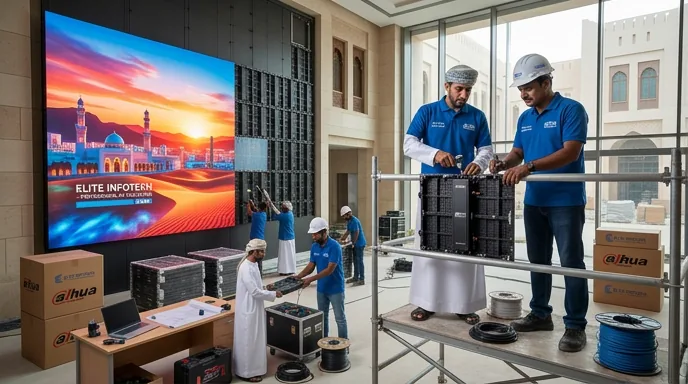
When an LED panel fails, the technician swaps a single faulty module — usually a 250mm × 250mm tile — with the rest of the screen still running. When an LCD panel fails, the entire display unit comes down and gets replaced. For installations on building facades, ramped malls, or 4‑metre lobbies, the difference between a 30-minute module swap and a half-day display replacement is the difference between a maintenance visit and a project.
LED vs LCD Cost: Upfront vs Lifetime
LCD wins on upfront cost. A 55-inch commercial LCD with 2,500-nit brightness, 24/7 operation rating, and a 3-year warranty lands in the OMR 800–1,200 range delivered. An equivalent-size LED video wall is OMR 2,500–4,500 depending on pixel pitch.
LED wins on lifetime cost when you account for three things: lifespan (LED runs roughly twice as long before needing replacement), repair model (module swap vs full replacement), and energy efficiency (commercial LED runs 30–40% lower wattage per square metre than equivalent-brightness LCD video walls). For a screen that will operate 12+ hours a day for 5+ years, our cost-per-display-hour calculations consistently favour LED above 65 inches and below P4 pixel pitch.
Below 65 inches — which covers most reception screens, menu boards, and meeting room displays — LCD is the right answer. The lifetime savings of LED do not materialise at that size, and the upfront premium does not pay back.
When to Choose Which: A Decision Framework
We use four questions to scope every commercial display project. The answers determine whether LED, LCD, or a mix is the right specification.
Indoor or outdoor?
- Outdoor → LED, no exception.
- Direct sun indoors (south-facing windows, atriums) → LED.
- Controlled lighting → Either — depends on next question.
Closest viewing distance?
- Under 2 m → LCD (LED pixel pitch is visible at close range).
- 2 – 4 m → LCD or P1.5–P2.5 LED.
- Over 4 m → LED, pitch matched to distance.
What is the screen size?
- Under 55" → LCD — mature, affordable, sharp.
- 55 – 98" → Either; LCD cheaper, LED longer-lived.
- Over 98" or non-standard shapes → LED.
Hours per day?
- Under 8 h/day, 5 days/week → LCD lifetime is sufficient.
- Over 12 h/day or 24/7 → LED — lifespan decides.
Common Business Applications and the Right Pick
| Application | Best Fit | Why |
|---|---|---|
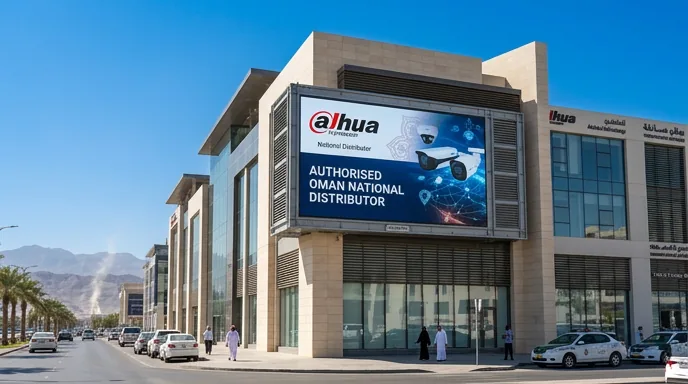
| Outdoor billboards & building facades | LED | 5,000+ nits, IP65, rated for 50°C operation in Oman summer. |
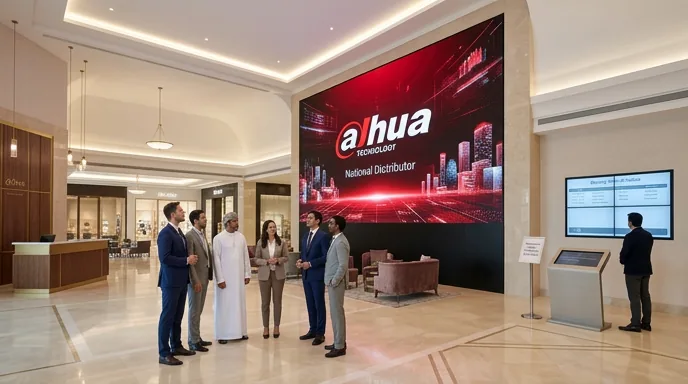
| Hotel lobby video walls (large, seamless) | LED | No bezel seams across the canvas; long life under 16+ h/day operation. |
| Mall & retail storefronts behind glass | LED (transparent) | Beats sun reflections; preserves daylight visibility into the shop. |
| Reception & lobby information screens (under 65") | LCD | Under 65", LED upfront premium does not pay back; LCD is sharp at close range. |
| Restaurant menu boards | LCD | Close viewing, controlled lighting, sub-65" panels — LCD’s sweet spot. |
| Boardroom displays & conference rooms | LCD | Close viewing distance under 4 m; LCD beats LED on per-pixel sharpness here. |
| Control rooms (24/7 monitoring) | Either — site-specific | Narrow-bezel LCD video walls excel under 4 m; LED takes over above. |
| Stadium / large-event screens | LED | Long viewing distance, scale, brightness — LCD cannot compete. |
| Mosque / prayer hall content displays | LCD or fine-pitch LED | Indoor, controlled lighting; depends on viewing distance and budget. |
Two Myths Worth Clearing Up
“My TV says ‘LED’ — is that the same as a commercial LED display?”
No. Almost every consumer television and commercial monitor sold today as “LED” is technically an LED-backlit LCD — an LCD panel with LEDs replacing the older fluorescent backlight. The marketing is misleading but technically defensible. A direct-view LED display, the kind used in stadium screens, outdoor billboards, and large video walls, is fundamentally different — every pixel emits its own light, with no LCD layer at all. When you ask a vendor for “LED,” specify whether you mean LED-backlit LCD or direct-view LED.
“LCD video walls are obsolete now.”
Not at all. For close-viewing applications under 4 metres — corporate boardrooms, broadcast studios, meeting rooms, gaming environments — narrow-bezel LCD video walls still produce the sharpest image at the lowest cost. The seams are visible but the per-pixel resolution beats most LED options below P1.2. The right answer is matching technology to viewing distance, not replacing every LCD wall with LED.
Choosing the Right Display for Your Project
Every project has its own constraints — the building, the viewers, the content, the budget, and Oman’s climate. We do site surveys across Muscat, Seeb, Sohar, Salalah, and Nizwa, and the recommendation we give after walking the site is often different from what the client expected before we visited.
If you are scoping an indoor commercial screen, our indoor LED display range covers fine-pitch panels for boardrooms, retail, and lobbies. For outdoor signage, our outdoor LED display range covers IP65 billboards engineered for Oman heat. For control rooms, our control room video wall solutions include 24/7-rated panels with module-swap repair.
Need help deciding? Contact us for a free site survey and proposal — we visit the site, measure ambient light, viewing distance, and content requirements, and recommend LED, LCD, or a combination based on what will actually perform.