
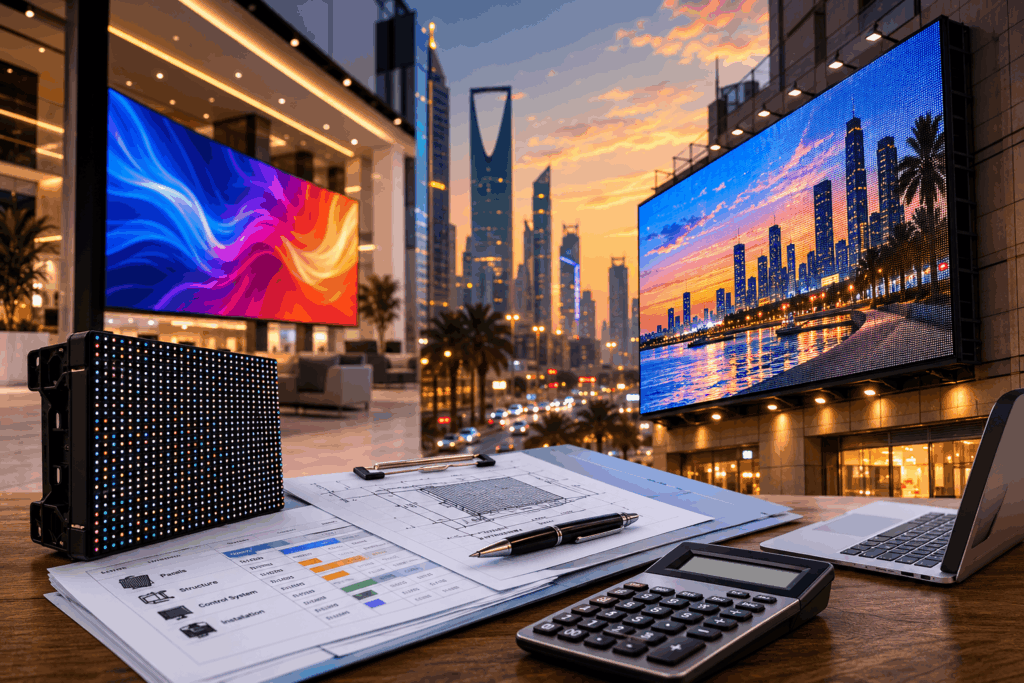
If you’ve started asking suppliers for LED screen quotes in Saudi Arabia, you’ve probably noticed something frustrating: almost nobody publishes real numbers. You get a range, a “depends on your project,” or silence until a sales call. That makes it hard to budget before you’ve even picked up the phone.
This guide breaks down exactly what drives LED screen pricing in the Saudi market, so you can walk into your next conversation with a supplier already knowing what to expect — and what questions to ask.
Quick Answer
In Saudi Arabia, LED screen prices are driven mainly by pixel pitch, panel size, and whether the screen is indoor or outdoor. Fine-pitch indoor displays cost more per square meter due to tighter LED spacing, while outdoor screens carry a premium for weatherproofing and higher brightness. A full project quote should also include the control system, structure, and installation, not just the panels.
Key Takeaways
- Pixel pitch is the single biggest price driver — tighter pitch means more LEDs per square meter and a higher cost.
- Outdoor LED screens cost more than indoor screens of the same size due to weatherproofing, brightness, and structural needs.
- Panel cost is only part of the budget — control systems, mounting structure, and installation labor add to the total.
- Larger screens can have a lower cost per square meter than small ones, due to how panels and controllers scale.
- A written quote should break out panels, structure, control system, and installation separately, not as one lump sum.
What Actually Determines LED Screen Price?
LED screen pricing isn’t a single number you can look up — it’s built from several variables that stack together. The main ones are:
- Pixel pitch — the distance between LEDs, which controls image sharpness and how many LEDs are packed into each panel
- Screen size — total square meterage of the display
- Indoor vs outdoor rating — outdoor panels need waterproofing, higher brightness, and more robust housings
- Brand and panel quality — established manufacturers with longer LED lifespans and better color calibration typically sit at a higher price point
- Control system — the processors and software that drive content onto the screen
- Installation complexity — a flat indoor wall is far simpler to install than a curved outdoor structure on a building facade
Understanding these variables matters more than memorizing a price list, because your specific combination of pitch, size, and environment is what a supplier will actually quote against.
LED Screen Price by Pixel Pitch
As a general rule, the tighter the pixel pitch, the higher the price per square meter, because more LEDs, driver chips, and PCB components are packed into the same panel area. Here’s how that typically breaks down by common use case:
| Pixel Pitch | Typical Use Case | Relative Price Level |
|---|---|---|
| P1.5 – P2.5 | Indoor control rooms, TV studios, close-viewing retail | Highest (fine detail, dense LEDs) |
| P3 – P4 | Indoor conference halls, retail walls, lobbies | High-mid |
| P4 – P6 | Semi-outdoor, event stages, exhibition booths | Mid |
| P6 – P10 | Outdoor billboards, stadium screens, building facades | Lower per sqm, larger area needed |
These are relative price bands, not fixed figures — actual cost depends on your supplier, panel brand, and project size. Use this table to understand which category your project falls into before requesting quotes. For a full walkthrough of what each pitch means and how to match it to your space, see our LED Screen Pixel Pitch Explained guide.
Indoor vs Outdoor LED Screens — Why Outdoor Costs More
It’s tempting to assume an outdoor screen and an indoor screen of the same size should cost roughly the same. In practice, outdoor screens usually cost more, for a few clear reasons.
Outdoor panels need IP65-rated (or higher) waterproof housings to survive rain, dust, and Saudi Arabia’s summer heat. They also need significantly higher brightness — often several times brighter than an indoor panel — to stay visible in direct sunlight. That combination of weatherproofing and high-brightness LEDs adds cost per panel.
On top of that, outdoor installations usually need a stronger mounting structure to handle wind load, plus additional cooling and drainage. An indoor screen in a lobby or conference room skips almost all of that. For the full breakdown of these differences, see Outdoor vs Indoor LED Screens: Key Differences, Costs and Applications.
Hidden Costs Buyers Often Forget
A common budgeting mistake is pricing only the LED panels and forgetting everything around them. Here’s what else typically factors into a full project cost.
Control System
This includes the video processor, sending and receiving cards, and playback software that get content onto the screen. Without it, the panels are just hardware — the control system is what actually makes them usable.
Mounting Structure
Steel framing, wall brackets, or a freestanding structure, depending on where the screen is going. Outdoor and large-format screens generally need more substantial (and more expensive) structural work than a simple indoor wall mount.
Installation and Labor
On-site assembly, cabling, calibration, and testing. Complex sites — building facades, stadiums, high ceilings — take longer and cost more to install than a straightforward indoor wall.
Maintenance and Support
Many suppliers offer service plans covering panel replacement, calibration checks, and software updates. This is usually optional but worth budgeting for on large or outdoor installations that see heavier wear.
How to Get an Accurate Quote for Your Project
The fastest way to get a number you can actually plan around is to bring specifics to your supplier rather than asking “how much does an LED screen cost.” Before you request a quote, have these details ready:
- The approximate size or dimensions of the space where the screen will go
- Whether the screen will be indoor, outdoor, or semi-outdoor
- How close the average viewer will stand (this determines the pixel pitch you actually need)
- Whether you need a curved, flat, or irregular-shaped display
If you’re evaluating options for a project in Jeddah or elsewhere in Saudi Arabia, Elite Infotech puts together itemized quotes that separate panels, control systems, structure, and installation, so you can see exactly where your budget is going rather than working from a single bundled number.
Frequently Asked Questions
How much does an LED screen cost in Saudi Arabia?
It depends on pixel pitch, size, and whether it’s indoor or outdoor. Fine-pitch indoor screens cost more per square meter than coarser-pitch outdoor screens, but outdoor installs add cost through weatherproofing and structure.
What is the price per square meter of an LED display?
Price per square meter varies by pixel pitch category — tighter pitches (like P1.5–P2.5) sit at the higher end, while larger-pitch outdoor screens (P6–P10) are typically lower per square meter, though the total project cost can still be higher due to overall size.
Is outdoor LED screen more expensive than indoor?
Generally yes, for a given size. Outdoor panels need waterproof housings, higher brightness, and sturdier structural support, all of which add to the base panel cost.
Does pixel pitch affect the price a lot?
Yes — it’s one of the biggest factors. A tighter pixel pitch means more LEDs and components packed into the same panel area, which increases manufacturing cost and therefore price.
What’s included in an LED screen quote besides the panels?
A complete quote should include the control system (processors and software), mounting structure, and installation labor. Some suppliers also offer ongoing maintenance as a separate line item.
Ready to Budget Your LED Screen Project?
Pricing an LED screen doesn’t have to feel like a black box. Once you know your pixel pitch range, size, and indoor/outdoor requirements, you’re already ahead of most first-time buyers walking into a quote request. If you want a detailed, itemized quote for your specific space in Saudi Arabia, Elite Infotech’s team can walk you through the numbers line by line.