
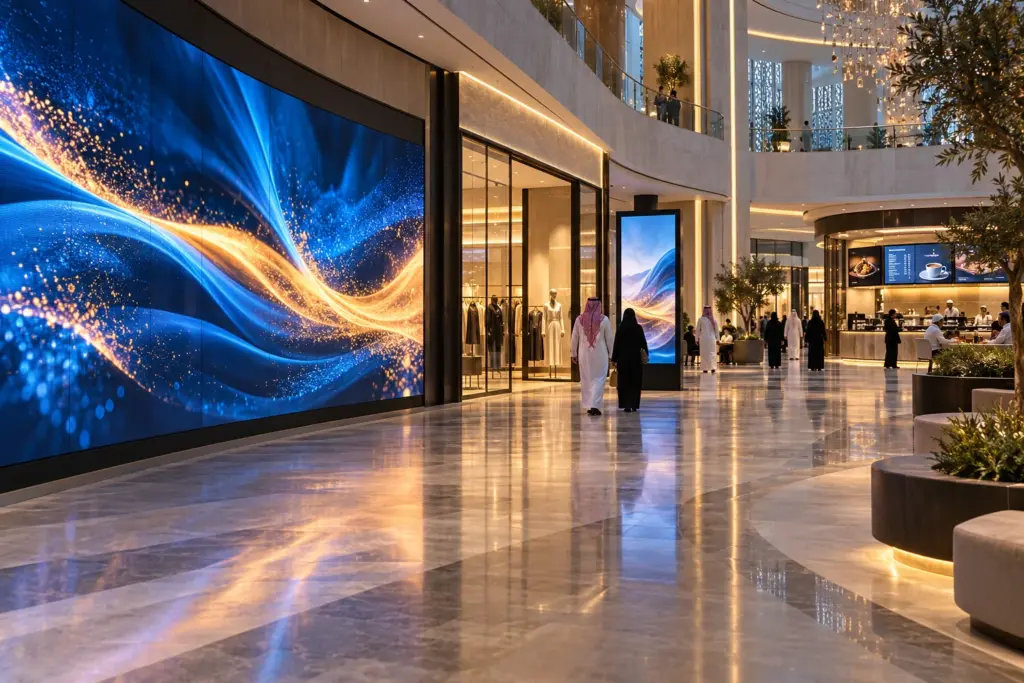
Walk into any new mall in Riyadh or Jeddah and try to find a printed poster. It’s getting harder. Menus glow, shop windows play video, and lobby walls change their message by the hour.
That’s digital signage, and it’s quickly becoming the standard way Saudi businesses talk to customers in person. If you’re wondering which type fits your business and whether it’s worth the investment, this guide walks you through it step by step.
Quick Answer
Digital signage in Saudi Arabia means using LED or LCD screens to show ads, menus, offers and information in shops, malls, restaurants, offices and public spaces. Content is updated remotely through software, so one screen can show many messages. LED suits large or bright spaces; LCD suits small, close-up displays.
Key Takeaways
- IMARC estimates Saudi Arabia’s digital signage market reached about USD 292 million in 2025; its figures describe the market, not a guaranteed return for an individual installation.
- Every system has three parts: the screen, a media player and content management software (CMS).
- Main screen types are indoor LED, outdoor LED, transparent LED, flexible LED, digital posters and LCD video walls.
- Digital signage cuts printing costs, lets you change offers instantly and supports Arabic and English content.
- Choosing the right type depends on viewing distance, ambient light and how often your content changes.
What Is Digital Signage?
Digital signage is any electronic screen used to display messages to people in a physical space. It replaces printed posters, menus and signs with screens that can show images, video, text and live data, all updated through software instead of a printer.
In this guide, LED means direct-view LED, where the LEDs form the image. An LCD may also use an LED backlight, but it remains a different display technology.
If a printed poster is a letter you mail once, digital signage is a group chat. You can send a new message whenever you want, to one screen or a hundred.
How Does Digital Signage Work?
Every digital signage setup, big or small, has the same three building blocks:
- The display. An LED or LCD screen that shows your content.
- The media player. A small device (sometimes built into the screen) that stores and plays content.
- The content management system (CMS). Software where you upload content, build playlists and schedule what plays when.
Here’s what that looks like in practice. A cafe manager in Dammam logs into the CMS on a laptop, uploads a new iced-coffee promo, and schedules it from 12 pm to 5 pm. Every screen across three branches updates within minutes. No printing, no delivery, no staff on ladders.
Types of Digital Signage in Saudi Arabia
The right screen depends on where it goes and how far away people stand. Here are the main types of digital signage Saudi businesses use.
Indoor LED screens
Indoor LED screens are built from modules that join seamlessly, so they can be any size, from a reception wall to a full stage backdrop. They’re bright, colourful and have no visible bezels. Common in malls, showrooms, auditoriums and corporate lobbies. Indoor LED Screens in Saudi Arabia: Complete Guide
Outdoor LED screens
Outdoor LED screens are sealed against dust and water and much brighter, so they stay readable in direct Saudi sun. They’re used for storefronts, building facades and billboards. LED Billboard Advertising in Saudi Arabia: Costs, Formats and Best Use Cases
Transparent LED screens
Transparent LED screens let light pass through, so you can mount them on a glass shopfront and still see inside the store. They’re popular with fashion and luxury retailers who want video in the window without blocking the view.
Flexible LED screens
Flexible LED screens bend around curves and columns. They let designers wrap a pillar in a mall atrium or build a curved feature wall that would be impossible with flat panels.
Digital poster screens
Digital poster screens are slim, portable, upright LED displays, about the size of a standard poster stand. You can roll one to the shop entrance on a busy weekend and move it to an event the next week.
Picture a perfume store in a Jeddah mall. A printed standee shows one product for a month. A digital poster at the entrance can cycle through new arrivals, a weekend discount and a gift-set promo, then switch to Ramadan offers overnight. If that kind of flexibility fits your store, take a look at portable digital poster screens for shops and events.
LCD screens and video walls
LCD screens are the familiar flat panels used for menu boards, waiting rooms and small displays seen up close. Several can be tiled into a video wall, though thin bezels between panels remain visible.
LED vs LCD Digital Signage: Which Should You Choose?
This is the question most buyers get stuck on. Here’s a side-by-side view.
| Factor | LED digital signage | LCD digital signage |
|---|---|---|
| Size | Any size, built from modules | Fixed panel sizes (e.g. 43″, 55″, 75″) |
| Bezels | Seamless | Visible lines in video walls |
| Brightness | Very high, suits sunlit and outdoor spaces | Model-dependent; high-brightness outdoor LCD models also exist |
| Best viewing distance | Depends on pitch; fine-pitch models also suit close viewing | Close up |
| Lifespan | Model-dependent; check rated life, duty cycle and warranty | Model-dependent; check backlight life, duty cycle and warranty |
| Upfront cost | Higher for small sizes, better value at large sizes | Lower for small screens |
| Best for | Feature walls, facades, atriums, billboards | Menu boards, counters, waiting areas |
As a starting point, consider direct-view LED for large seamless surfaces and LCD for smaller close-viewing displays. Compare the actual models, ambient light, content and maintenance needs before choosing.
Benefits of Digital Signage for Saudi Businesses
Why are so many Saudi businesses switching? Here are the benefits that matter most.
- Instant updates. Change prices, offers or messages in minutes, across every branch.
- Lower printing costs. No reprinting posters for every promotion, season or price change.
- More attention. Moving content catches the eye far better than static print.
- Bilingual by design. Show Arabic and English versions in the same loop, or schedule each for different audiences.
- Time-based messaging. Run breakfast offers in the morning, family deals in the evening and suhoor menus during Ramadan.
- Extra revenue. Malls and large stores can sell screen time to brands.
- Measurable results. Many CMS platforms show play logs, and some connect to footfall or sales data.
Digital Signage Business Applications by Industry
| Industry | How digital signage is used |
|---|---|
| Retail and fashion | Window displays, new arrivals, in-store promotions |
| Malls | Atrium feature walls, wayfinding, sponsored ad screens |
| Restaurants and cafes | Digital menu boards, combo offers, queue screens |
| Hotels | Lobby welcome walls, event schedules, conference room signs |
| Corporate offices | Reception branding, internal announcements, KPI dashboards |
| Banks and clinics | Queue management, service information, health or finance tips |
| Events and exhibitions | Stage backdrops, booth screens, sponsor loops |
| Car showrooms | Model videos, finance offers, feature walls |
How to Plan a Digital Signage Project
Follow these steps to avoid costly mistakes.
- Define your goal. Sell more, inform visitors, build your brand, or sell ad space? The goal shapes everything else.
- Measure the space and viewing distance. How far will people stand from the screen? This decides pixel pitch and size.
- Choose the screen type. For most feature walls, lobbies and mall atriums, an indoor LED screen built to fit your space gives the seamless, bright result people remember. For close-up counters, LCD may be enough.
- Pick your CMS. Make sure it supports Arabic text, scheduling and multi-branch control.
- Plan your content. A great screen with weak content is wasted. Plan at least a month of content before launch.
- Confirm support. Ask about installation, warranty, spare parts and response times inside Saudi Arabia.
How to Choose an LED Screen in Saudi Arabia
Frequently Asked Questions
What is digital signage?
Digital signage is the use of electronic screens, like LED or LCD displays, to show ads, menus, information or branding in physical spaces. Content is managed and updated remotely through software.
What is the difference between LED and LCD digital signage?
LED screens are built from modules, can be any size, are very bright and have no bezels. LCD screens come in fixed sizes and work best for small displays viewed up close.
How is content updated on digital signage?
Through a content management system (CMS). You upload images or videos, arrange them into playlists and schedule when they play, often from a laptop or phone.
Is digital signage worth it for a small business in Saudi Arabia?
Often, yes. A single digital poster or menu screen can replace repeated printing costs and help promote time-based offers. Start small and expand once you see results.
Can digital signage show Arabic and English content?
Yes. Most modern CMS platforms support Arabic right-to-left text, so you can run bilingual content in one loop or schedule each language separately.
Your Screens, Your Message, Your Timing
You now understand how digital signage in Saudi Arabia works, which screen types fit which spaces, and how to plan a project that pays off. That’s the hardest part done.
When you’re ready to see what’s possible in your space, browse Elite Infotech’s LED and digital display solutions or look through recent installs on the projects page.